
Generating and testing hypothesis is only one of many instructional strategies necessary for effective teaching and learning. Since no instructional strategy works equally well in all situations, teachers are the experts in the classroom and should rely on their knowledge of their students, their subject matter, and their situation to identify the most appropriate instructional strategies. The focus of today’s conversation is a deep dive into 1 of Marzano’s 9 instructional strategies: Generating and Testing Hypotheses. We will focus on the generating and testing hypotheses strategy specifically in relation to utilizing the makerspace as an additional learning environment you can use to effectively implement this strategy as you see fit.
Let’s begin with a story. James is starting 4th grade. He consistently scores in the 40th percentile in both Math and Reading on his annual MAPS and ACT Aspire testing. He is polite and respectful in class, but is often unmotivated to “try harder”. He is often nervous about doing things the “wrong way” since the previous 3rd grade teacher explicitly explains exactly the way things are to be done. His teacher believes he lacks focus in class and would do much better with more effort. He is on the “bubble” of meeting district goals in test scores so he receives more individualized and small group instruction than most students. Despite this, James’ test scores remained consistent during 3rd grade.
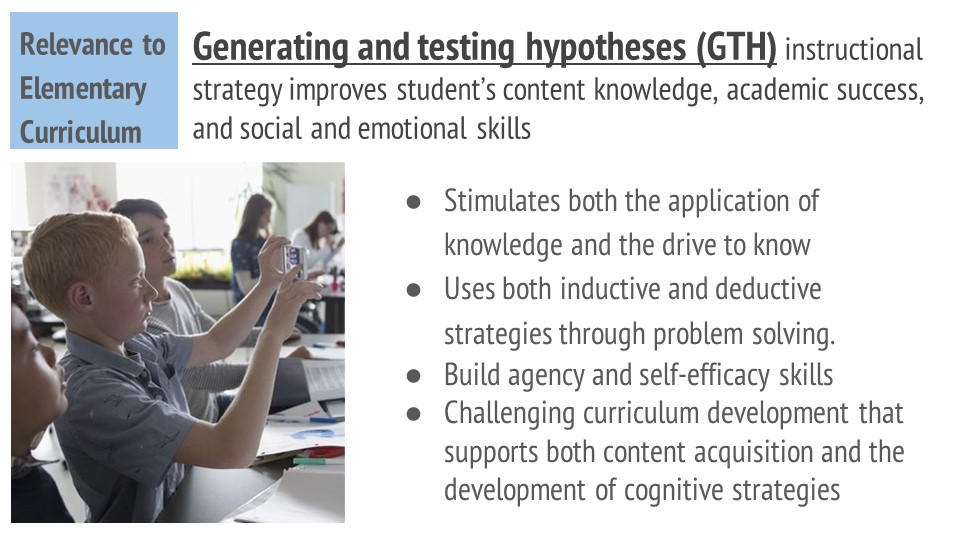
Now we introduce a GTH strategy along with a Makerspace at the school. James’ new 4th grade teacher uses a variety of strategies to engage the class. Using the GTH strategy, James 4th grade teacher gives students an authentic problem to solve. The door to the library won’t stay open and needs a device built to stop the door from closing. Throughout the project, the teacher (1) provides mentoring so that students can overcome barriers, (2) Directly teaches several lessons on geometric measurement, measurement, and data, (3) Connects the math based project to writing standards: Production and distribution of writing and research to build and present knowledge and (4) Finally, the teacher addresses social, emotional lessons like leadership and collaboration since the students will be working with partners. Over the course of several days, students are given opportunities to identify different solutions and hypothesize which solution is likely to work. The students are given time in the makerspace to physically make their device and test it on the library door.
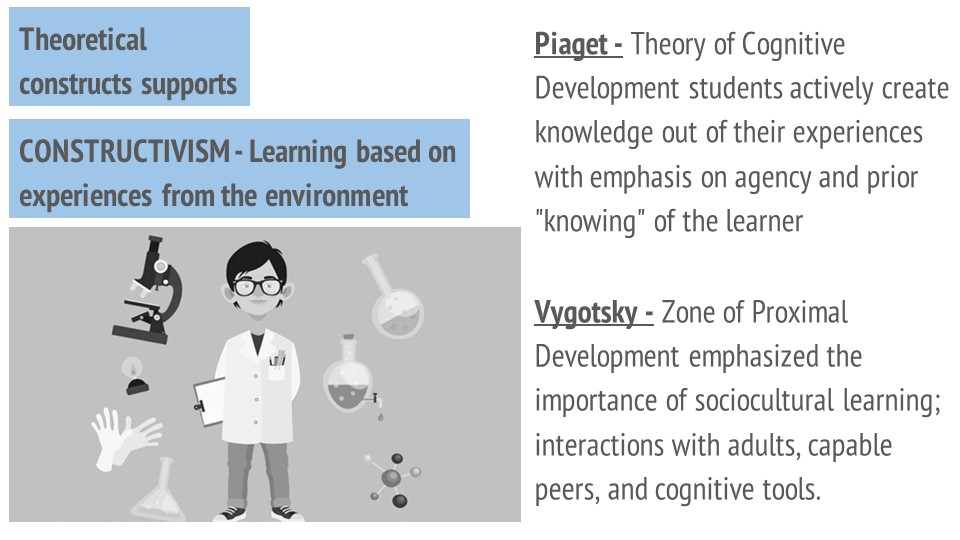
While Makerspaces seem like new concepts, these initiatives and the GTH tasks are deeply rooted in Constructivist educational theories. Piaget’s Theory of Cognitive Development theorizes that students actively create knowledge out of their experiences and an emphasis is placed on agency and experience of the learner. Vygotsky’s Zone of Proximal Development theory emphasizes the importance of sociocultural learning; how interactions with adults, more capable peers, and cognitive tools are internalized by learners to form mental constructs through the zone of proximal development.
How does it work in the classroom? Implementation of the GTH strategy can be utilized in any classroom for any subject. GTH, specifically as it relates to problem solving has not always been easy to execute in the classroom. The makerspace is a separate, collaborative work space inside the school that can facilitate an area for problem solving. While this can certainly be done in your classrooms this space is specifically designed for collaborative group work and access to resources and materials that teacher don’t have to manage or maintain in their classrooms.
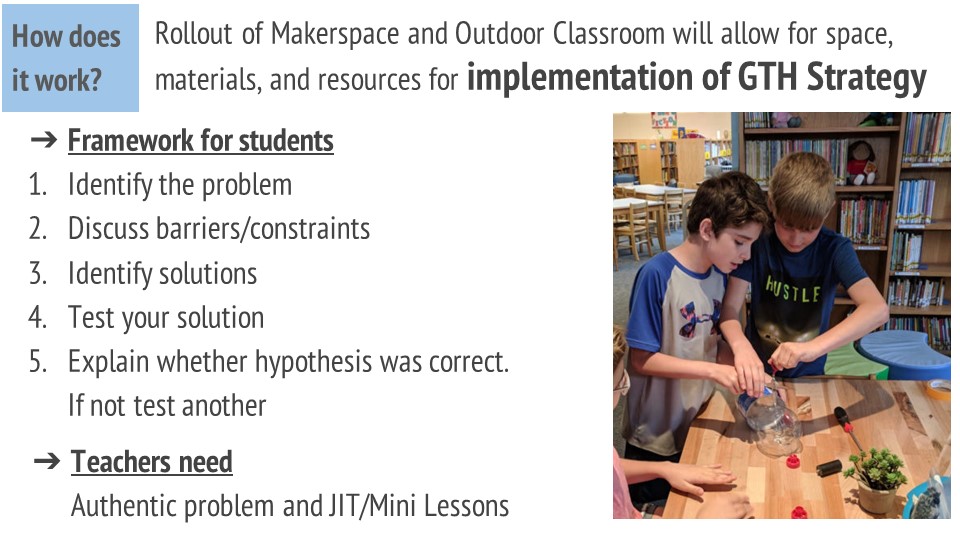
The use of this space generally would follow this guiding framework, but again teachers are the expert practitioners in deciding how to best implement into their classroom and curriculum. General Framework for students: Identify the problem, Discuss barriers/constraints, Identify potential solutions, generate a hypothesis, Test your solution through simulation or physically, explain whether your hypothesis was correct. Determine if you want to test another hypothesis using a different solution.
General Framework to teachers would be to find an authentic problem, be prepared for “Just in Time” or mini-lessons as we described earlier with our 4th grader James. Students will arrive at different reflection points or need knowledge at different stages. As in the case with our 4th grader James’ he arrived at a point in the project where he needed to know additional information about geometric measurements, specifically triangles. At the moment his drive to learn was peaked, the lesson is available to him.
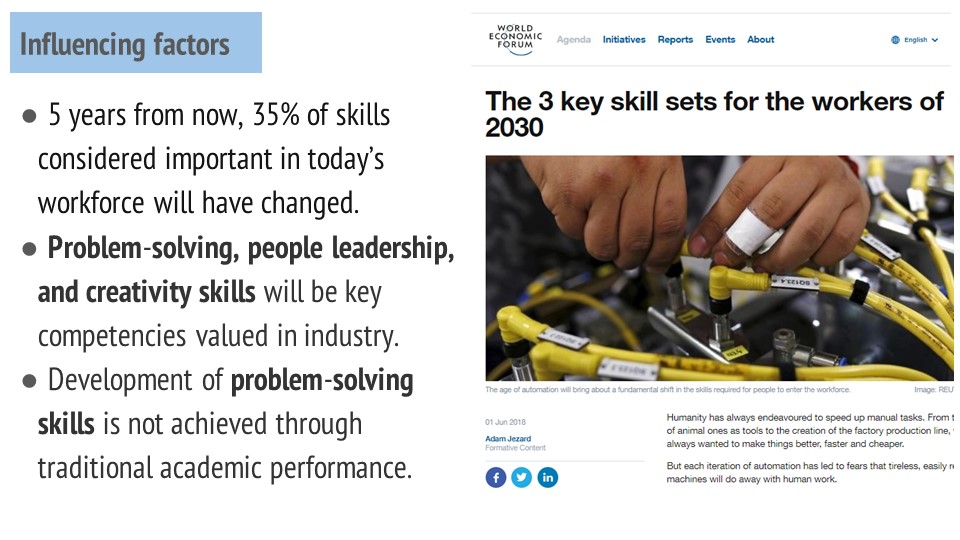
The next question would be “why?” And the answer to that is ultimately the world our students will compete in will look different than it does today and we need to prepare them for those challenges. The World Economic Forum article reporting on data from the McKinsey Global Institute report identified creativity, problem solving, and people leadership as skills that will grow in importance over the next decade. Five years from now, 35% of skills that are considered important in today’s workforce will have changed.
Generic problem-solving skills have been identified as one of the key competencies valued by university students, employers and industry at-large.
The development of problem-solving skills is not achieved through traditional academic performance. In fact, a study involving 130 third-year science students during three consecutive years indicated a lack of correlation between problem-solving skills and academic performance. The study indicates that these are 2 independent skills sets. Additionally, relevant studies have demonstrated that epistemic curiosity, which reflects a “drive to know” was significantly associated with student learning, engagement, achievement goals. So in order to prepare students for the challenges of secondary education and beyond, we have to address these essential skills alongside content knowledge.
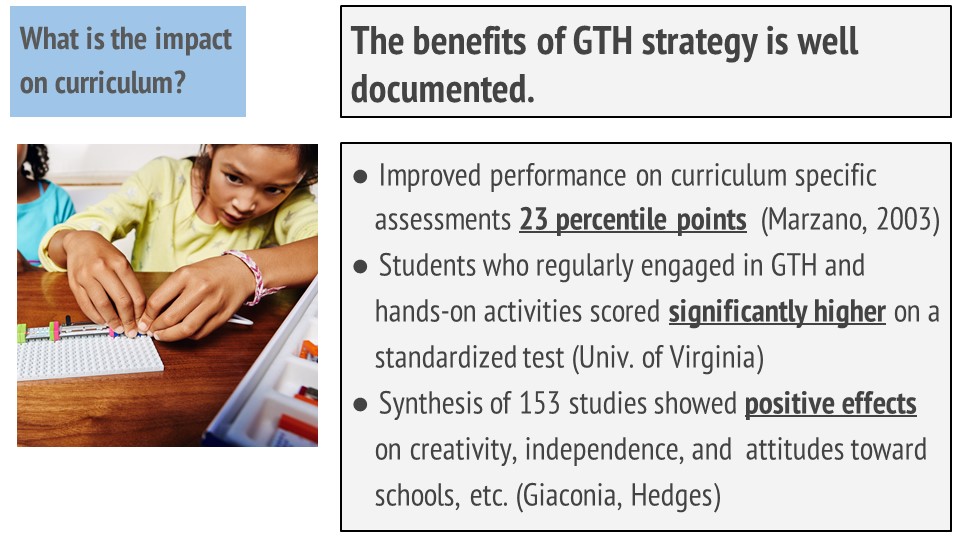
The benefits of utilizing generating and testing hypotheses strategy is well documented. Studies documented in the “What works in schools: Translating research into Action provide clear guidance on the specific of effective teaching. GTH specific strategies resulted in a percentile gain of 23 points on curriculum specific assessments. A study on science education out of the University of Virginia found that “students who engaged in hands-on activities every day or once a week scored significantly higher on a standardized test of science achievement than students who engaged in hands-on activities once a month, less than once a month, or never.” According to a compilation of project-based learning (PBL) research from Edutopia , “A 2016 MDRC/Lucas Education Research literature review found that the design principles most commonly used in PBL align well with the goals of preparing students for deeper learning, higher-level thinking skills, and intra/interpersonal skills.”
GTH Strategy is a High-Yield Instructional Strategy that positively affects student achievement in content and and social emotional skills, but it provides benefits for the teacher as well. GTH promotes student ownership of learning which provides relief from the excessive teacher/student interaction of whole-group teaching, it frees time for the interactive engagement of students, presents opportunities for targeted cues, engagement, correctives, and reinforcement. It may encourage students to think for themselves about the organization of subject matter and the productive allocation of time.
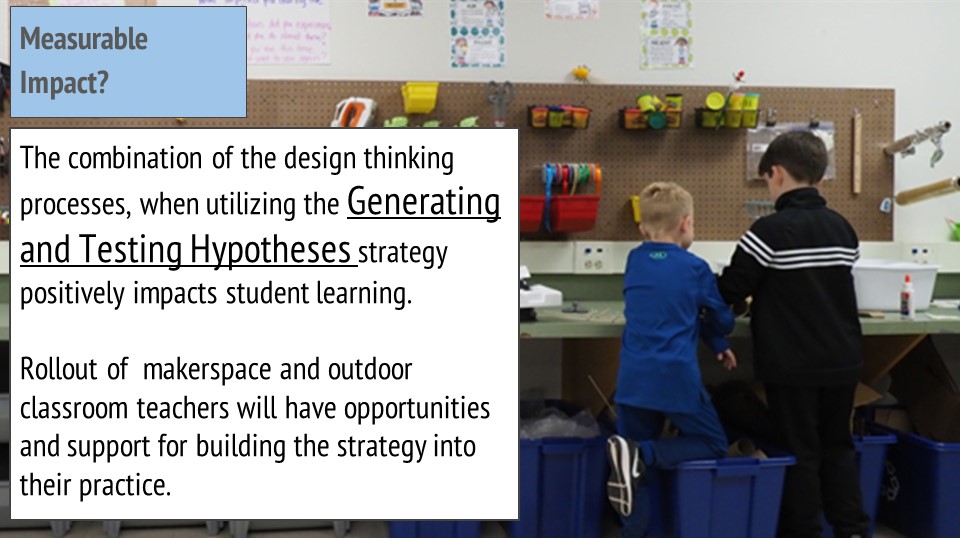
Standardized test scores may never accurately reflect the impact that GTH through problem solving have on student achievement. Rather, it is a combination of the thinking processes, required by utilizing the GTH strategy that positively impact student learning. The makerspace and the outdoor classroom will provide opportunities for teachers to utilize GTH strategies in an authentic way that will not only address curriculum standards and developing content knowledge, but to be able to address skills that students will need to be more prepared for the future.
So let’s come back to our 4th grader James. He finished 4th grade and is moving on to middle school this fall. Where did his scores land at the end of 4th grade? 78th percentile in Reading and 82nd percentile in Math. Was it his teacher’s effective use of the Generating and Testing Hypotheses strategy? No, not in total, but qualitatively, we know it made a difference in the way he feels about school and that might have been a turning point for him.
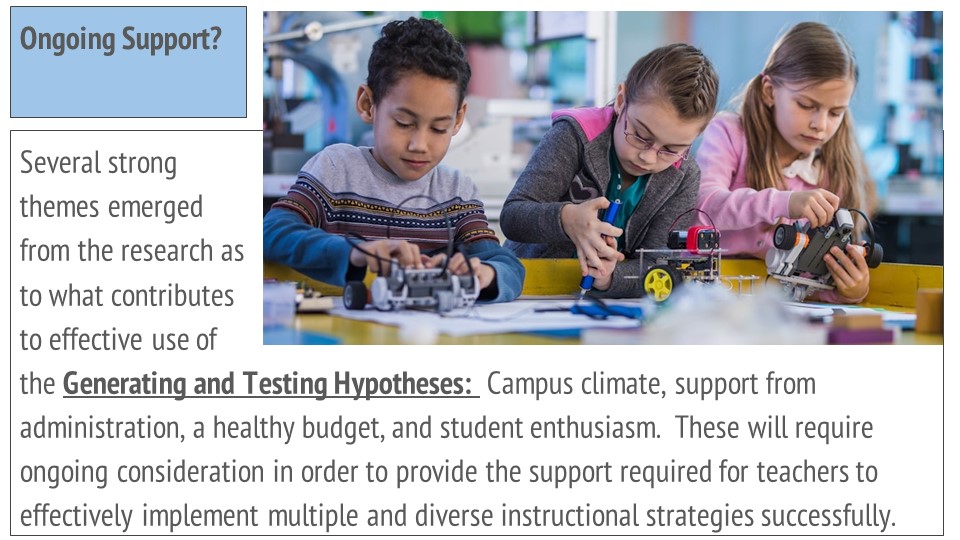
No instructional strategy works equally well in all situations. As Marzano says, Instructional strategies are only tools. Several themes emerged from the research as contributing factors to effective use of the GTH instructional strategy success. Campus climate, support from administration, a healthy budget, and student enthusiasm, were needed for successful implementation of strategies. So, what is needed to sustain this and to really provide support for teachers who effectively use this strategy. We are lucky in that the district and community are partners in this endeavor with a local Foundation granting $10,000 for the Makerspace and PTO has allocated another $3,000 for Makerspace and Outdoor Classroom. The implementation of instructional strategies could positively impact students, the school, and the community at large.
- Avneet Hira A., Hynes M. (June 2018). People, Means, and Activities: A Conceptual Framework for Realizing the Educational Potential of Makerspaces Hindawi Education Research International Volume 2018, Article ID 6923617, 10 pages, Retrieved from Dean B. Ellis Library https://doi.org/10.1155/2018/6923617
- Bughin J., Hazan E., Lund S. Dahlström P. , Wiesinger A, Subramaniam A. McKenzie, (May 2018). Global Institute SKILL SHIFT AUTOMATION AND THE FUTURE OF THE WORKFORCE, Retrieved from https://www.mckinsey.com/~/media/McKinsey/Featured%20Insights/Future%20of%20Organizations/Skill%20shift%20Automation%20and%20the%20future%20of%20the%20workforce/MGI-Skill-Shift-Automation-and-future-of-the-workforce-May-2018.ashx
- Erena A., Coskunb H. (December 2014). Students’ level of boredom, boredom coping strategies, epistemic curiosity, and graded performance. The Journal of Educational Research, Volume 109, 2016 – Issue 6, Retrieved from Dean B. Ellis Library http://dx.doi.org/10.1080/00220671.2014.999364
- Google Education (May 2019) Emerging Trends in K-12 Education: Global Edition Retrieved from https://edu.google.com/latest-news/future-of-the-classroom/?modal_active=none
- Lawson A. (2003) The nature and development of hypothetico‐predictive argumentation with implications for science teaching, International Journal of Science Education, 25:11, 1387-1408
- Lee J. Kwon Y. (November 2010) Learning-Related Changes in Adolescents’ Neural Networks During Hypothesis-Generating and Hypothesis-Understanding Training Springer Science+Business Media B.V. 2010
- Levyhh, M. (November 2008). The Affective Establishment and Maintenance of Vygotsky’s Zone of Proxmial Development. Educational Theory, Vol. 58 Issue 1, p83-101. 19p. Retrieved from Dean B. Ellis Library http://eds.b.ebscohost.com.ezproxy.library.astate.edu/ehost/detail/detail?vid=3&sid=313a1a0a-c896-4064-a823-57b6c0e97e8c%40pdc-v-sessmgr03&bdata=JnNpdGU9ZWhvc3QtbGl2ZQ%3d%3d#AN=28794170&db=trh
- Marzano R., Gaddy B. Dean C. (2003). What Works In Classroom Instruction, Chapter 9 p. 111-120 Retrieved from http://www.peecworks.org/peec/peec_research/I01795EFA.3/Marzano%20What_Works.pdf
- Marzano, R., (2003) What works in Schools: Translating Research into Action, Alexandria, VA, Association for Supervision and Curriculum Development
- Maraono R. (September, 2009) Setting the Record STRAIGHT on “High-Yield” Strategies, Source: Phi Delta Kappan Retrieved from http://content.ebscohost.com/ContentServer.asp?T=P&P=AN&K=504319714&S=R&D=eue&EbscoContent=dGJyMNHr7ESeqK84yOvqOLCmr1Gep7ZSsau4TK%2BWxWXS&ContentCustomer=dGJyMPGut1Cwr7RRuePfgeyx44Dt6fIA
- Peppler K., Bender S., (November 2013). Maker Movement Spreads Innovation One Project at a Time, retrieved from Retrieved https://journals.sagepub.com/doi/10.1177/003172171309500306
- Tan, M. (September 2018) When Makerspaces Meet School: Negotiating Tensions Between Instruction and Construction. Journal of Science Education and Technology (2019) 28:75–89 Retrieved from Dean B. Ellis Library https://doi.org/10.1007/s10956-018-9749-x
- Tatter G. (April 2019) Teaching for Deeper Learning: How great teachers inspire class participation, student engagement, and learning Harvard Graduate School of Education Usable Knowledge Retrieved from https://www.gse.harvard.edu/news/uk/19/04/teaching-deeper-learning
- Stornaiuolo, A. & Nichols, T.P. (2018). Mobilizing Audiences in High School Makerspaces. Teachers College Record, 120(8),. Retrieved July 21, 2019 from https://www.learntechlib.org/p/189296/
 Imel Learning