Featured

The fear and humiliation brought by corporal punishment is not acceptable in our schools

A letter to:

Sen. Jane English, Chair, Arkansas State Senate Education Committee

Sen. Joyce Elliot, Vice-Chair, Arkansas State Senate Education Committee

Arkansas Department of Education

My name is Jessica Imel and I am a resident of Arkansas. Among other roles, I am a teacher for a large school district.  I am writing to you as a concerned citizen to ask that you and the other members of the Education Committee work to eliminate the use of corporal punishment in all schools in the state of Arkansas.

My district does not use corporal punishment.  As a teacher of 8 years with a rating of “Distinguished” for the last 5 years, I have obviously had to implement a variety of effective classroom management and disciplinary techniques.  In my naivety, I was actually not aware any school in the state was using corporal punishment as a disciplinary tool until we met a child who attends a rural school district in Arkansas.  In order to protect his privacy, I will call him KR.

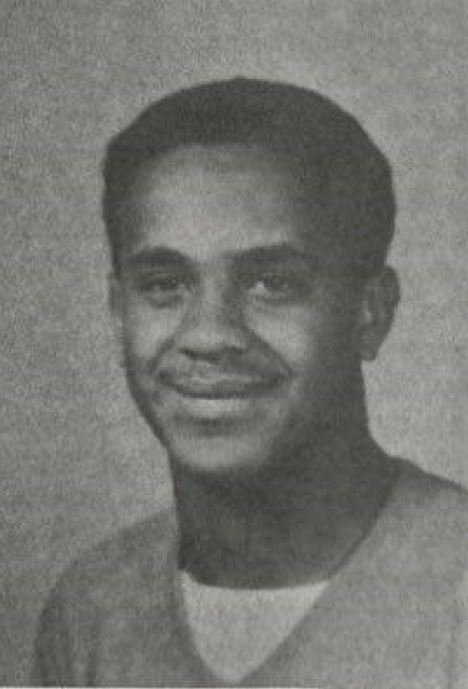
My family and I met KR at a family/friends gathering several years ago.  He is a kind and humorous teen who loves the outdoors, hands-on activities, and video games.  Sadly, KR has experienced several adverse childhood experiences.  Since meeting KR, he has been a pseudo nephew to my husband and I, despite not being related to him. KR and my son have formed a friendship over the last few years that we encourage and support.  KR has stayed with us during holidays and traveled with us on occasion.  Although he is in another town, we regularly see him through various family/friend gatherings.

Over the Christmas break, KR told me that he got in trouble at school for talking and because it was not his first offense was given “swats” by his Assistant Principal.  I was stunned.  I was thankful KR confided in me, but was saddened and angry hearing his story.  He admitted he was in fact doing something wrong in class, but as he described it, going to the Assistant Principal’s office and being swatted by the administrator was humiliating.

Arkansas Law and School leadership allowed its representative to hit a child who is already struggling to build relationships within the school and stay engaged in his classes.  From my conversations with KR, I glean that he is desperate for teachers, mentors and coaches to invest in him, but now the school administration has humiliated and embarrassed him.

I could cite numerous research sources that indicate positive relationships are a foundation to student success.  I can also attest to this personally as I work to build a culture of high expectations and caring relationships in my classroom.

The fear and humiliation brought by corporal punishment is not acceptable in our schools.  This event has further disintegrated KR’s engagement in school and if other school districts are utilizing corporal punishment as a disciplinary tool, they are likely working against the success and achievement of Arkansas students.

I feel compelled to advocate on KR’s behalf because I believe every child should experience a joy for learning.  Positive learning experiences in our Arkansas schools have a direct, positive impact on Arkansas’ education outcomes, public safety, health and wellness, and economic strength. 

I urge you to discontinue the use of corporal punishment for every school district in the state of Arkansas.  Thank you for your time.  If I can be of any assistance or answer further questions, please do not hesitate to contact me. 

Jessica Imel

Featured

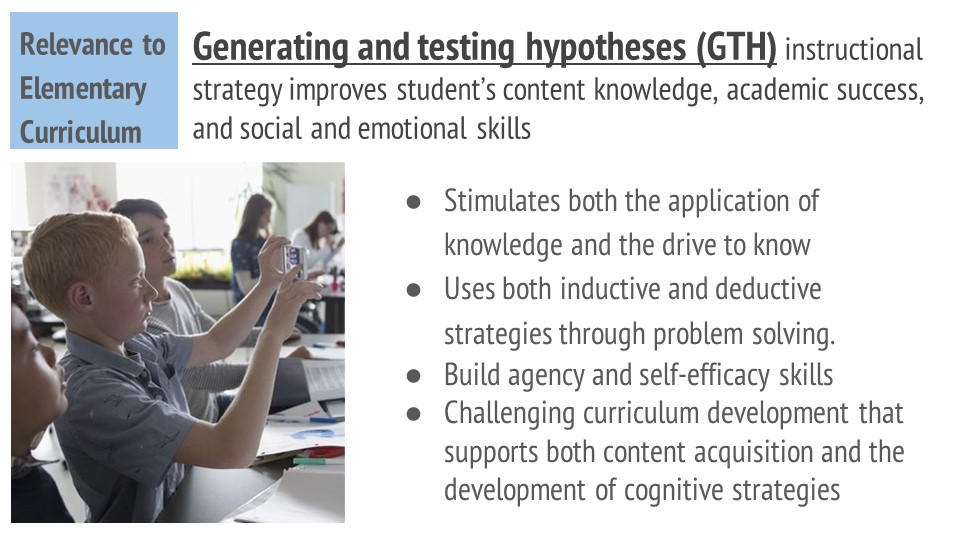
Utilizing a Makerspace to incorporate Marzano’s Generating and Testing Hypotheses Instructional strategy

Generating and testing hypothesis is only one of many instructional strategies necessary for effective teaching and learning.  Since no instructional strategy works equally well in all situations, teachers are the experts in the classroom and should rely on their knowledge of their students, their subject matter, and their situation to identify the most appropriate instructional strategies.  The focus of today’s conversation is a deep dive into 1 of Marzano’s 9 instructional strategies:  Generating and Testing Hypotheses.  We will focus on the generating and testing hypotheses strategy specifically in relation to utilizing the makerspace as an additional learning environment you can use to effectively implement this strategy as you see fit. 

Let’s begin with a story.  James is starting 4th grade.  He consistently scores in the 40th percentile in both Math and Reading on his annual MAPS and ACT Aspire testing.  He is polite and respectful in class, but is often unmotivated to “try harder”.  He is often nervous about doing things the “wrong way” since the previous 3rd grade teacher explicitly explains exactly the way things are to be done.  His teacher believes he lacks focus in class and would do much better with more effort.  He is on the “bubble” of meeting district goals in test scores so he receives more individualized and small group instruction than most students.  Despite this, James’ test scores remained consistent during 3rd grade. 

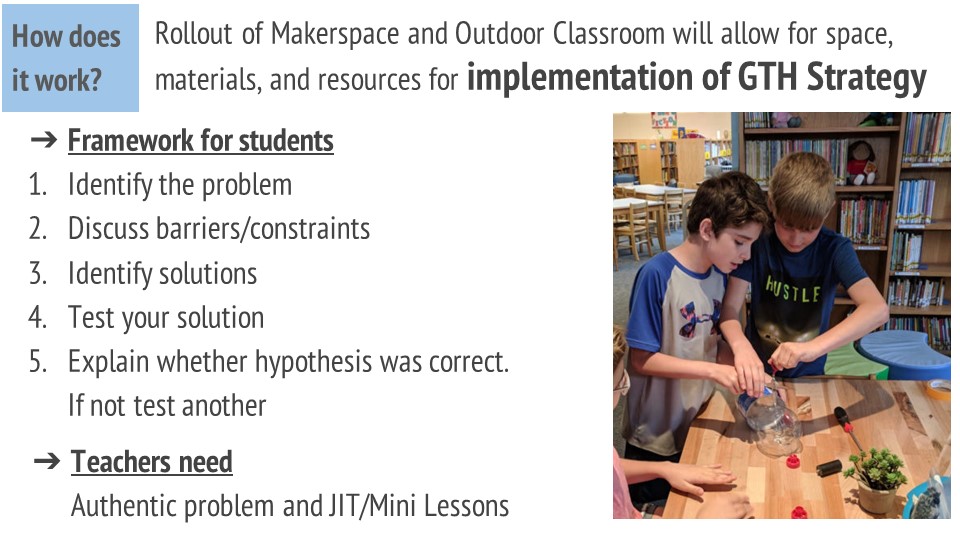
Now we introduce a GTH strategy along with a Makerspace at the school.  James’ new 4th grade teacher uses a variety of strategies to engage the class.  Using the GTH strategy, James 4th grade teacher gives students an authentic problem to solve.  The door to the library won’t stay open and needs a device built to stop the door from closing.  Throughout the project, the teacher (1) provides mentoring so that students can overcome barriers, (2) Directly teaches several lessons on geometric measurement, measurement, and data, (3) Connects the math based project to writing standards:  Production and distribution of writing and research to build and present knowledge and (4) Finally, the teacher addresses social, emotional lessons like leadership and collaboration since the students will be working with partners.  Over the course of several days, students are given opportunities to identify different solutions and hypothesize which solution is likely to work.  The students are given time in the makerspace to physically make their device and test it on the library door.

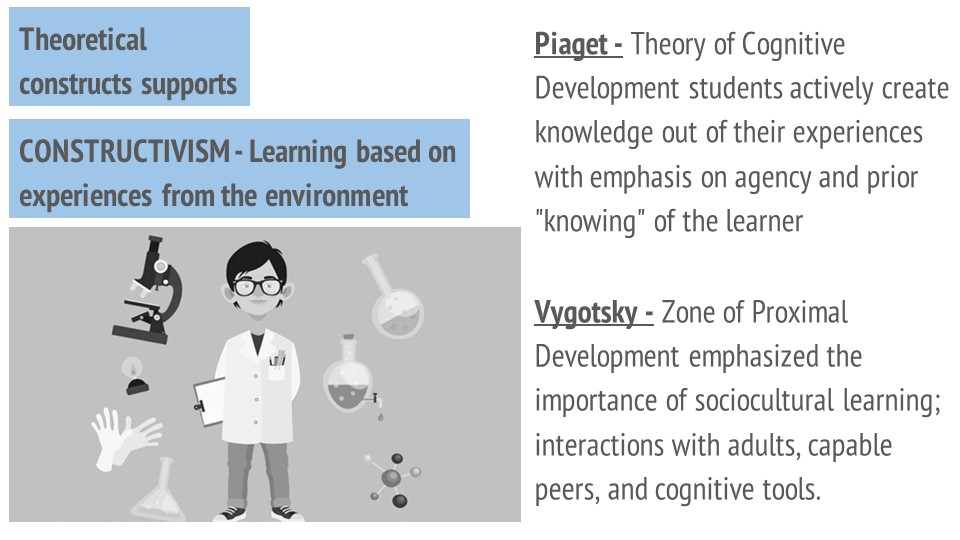
While Makerspaces seem like new concepts, these initiatives and the GTH tasks are deeply rooted in Constructivist educational theories.  Piaget’s Theory of Cognitive Development theorizes that students actively create knowledge out of their experiences and an emphasis is placed on agency and experience of the learner.  Vygotsky’s Zone of Proximal Development theory emphasizes the importance of sociocultural learning; how interactions with adults, more capable peers, and cognitive tools are internalized by learners to form mental constructs through the zone of proximal development.

How does it work in the classroom? Implementation of the GTH strategy can be utilized in any classroom for any subject.  GTH, specifically as it relates to problem solving has not always been easy to execute in the classroom.  The makerspace is a separate, collaborative work space inside the school that can facilitate an area for problem solving. While this can certainly be done in your classrooms this space is specifically designed for collaborative group work and access to resources and materials that teacher don’t have to manage or maintain in their classrooms.

The use of this space generally would follow this guiding framework, but again teachers are the expert practitioners in deciding how to best implement into their classroom and curriculum.  General Framework for students: Identify the problem, Discuss barriers/constraints, Identify potential solutions, generate a hypothesis, Test your solution through simulation or physically, explain whether your hypothesis was correct.  Determine if you want to test another hypothesis using a different solution.

General Framework to teachers would be to find an authentic problem, be prepared for “Just in Time” or mini-lessons as we described earlier with our 4th grader James.  Students will arrive at different reflection points or need knowledge at different stages. As in the case with our 4th grader James’ he arrived at a point in the project where he needed to know additional information about geometric measurements, specifically triangles.  At the moment his drive to learn was peaked, the lesson is available to him. 

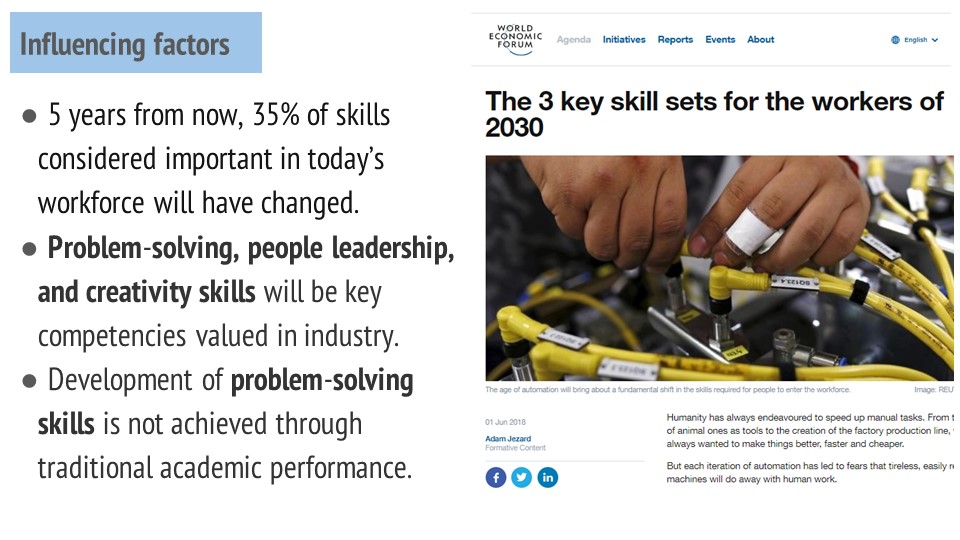
The next question would be “why?”  And the answer to that is ultimately the world our students will compete in will look different than it does today and we need to prepare them for those challenges.  The World Economic Forum article reporting on data from the McKinsey Global Institute report identified creativity, problem solving, and people leadership as skills that will grow in importance over the next decade.  Five years from now, 35% of skills that are considered important in today’s workforce will have changed. 

Generic problem-solving skills have been identified as one of the key competencies valued by university students, employers and industry at-large.

The development of problem-solving skills is not achieved through traditional academic performance.  In fact, a study involving 130 third-year science students during three consecutive years indicated a lack of correlation between problem-solving skills and academic performance.  The study indicates that these are 2 independent skills sets.  Additionally, relevant studies have demonstrated that epistemic curiosity, which reflects a “drive to know” was significantly associated with student learning, engagement, achievement goals.  So in order to prepare students for the challenges of secondary education and beyond, we have to address these essential skills alongside content knowledge.

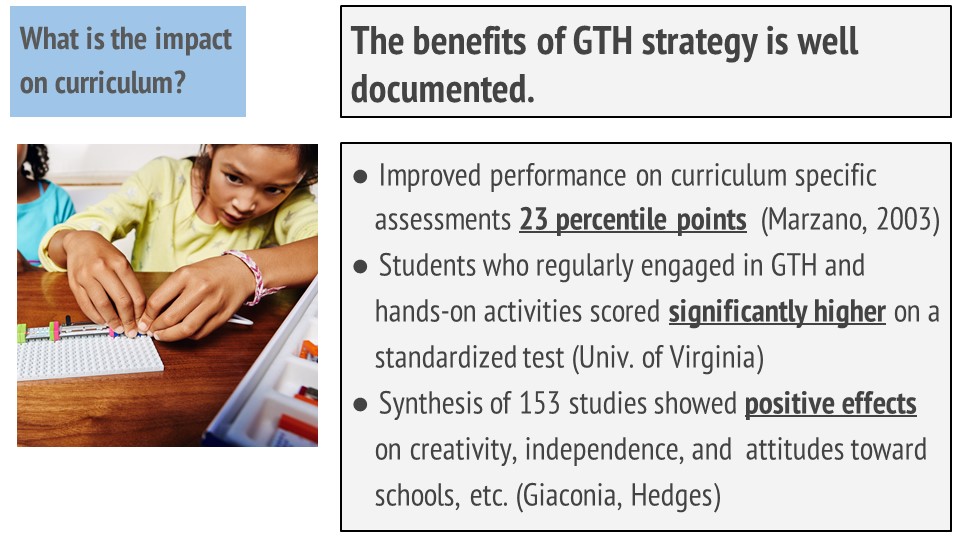
The benefits of utilizing generating and testing hypotheses strategy is well documented.  Studies documented in the “What works in schools: Translating research into Action provide clear guidance on the specific of effective teaching.  GTH specific strategies resulted in a percentile gain of 23 points on curriculum specific assessments.  A study on science education out of the University of Virginia  found that “students who engaged in hands-on activities every day or once a week scored significantly higher on a standardized test of science achievement than students who engaged in hands-on activities once a month, less than once a month, or never.” According to a compilation of project-based learning (PBL) research from Edutopia , “A 2016 MDRC/Lucas Education Research literature review found that the design principles most commonly used in PBL align well with the goals of preparing students for deeper learning, higher-level thinking skills, and intra/interpersonal skills.”

GTH Strategy is a High-Yield Instructional Strategy that positively affects student achievement in content and and social emotional skills, but it provides benefits for the teacher as well. GTH promotes student ownership of learning which provides relief from the excessive teacher/student interaction of whole-group teaching, it frees time for the interactive engagement of students, presents opportunities for targeted cues, engagement, correctives, and reinforcement.  It may encourage students to think for themselves about the organization of subject matter and the productive allocation of time.

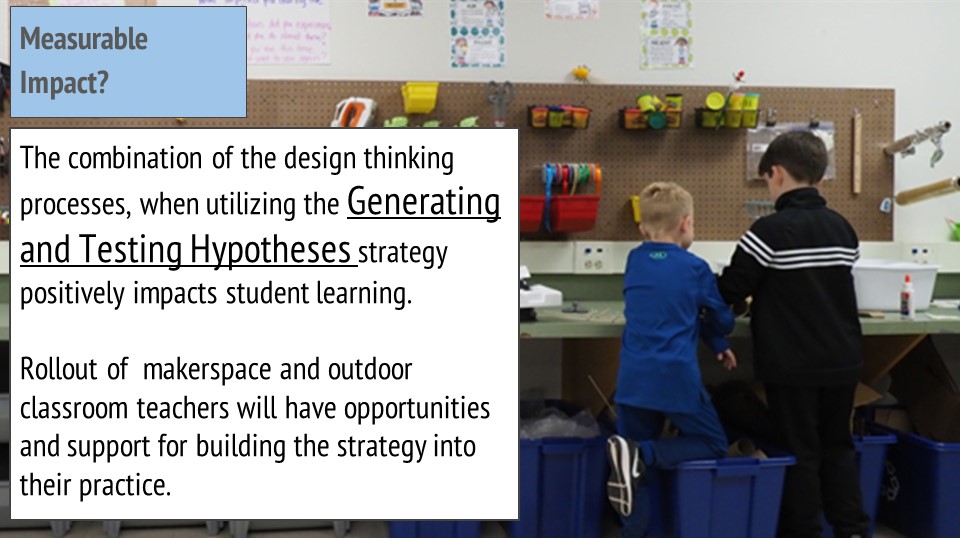
Standardized test scores may never accurately reflect the impact that GTH through problem solving have on student achievement. Rather, it is a combination of the thinking processes, required by utilizing the GTH strategy that positively impact student learning.  The makerspace and the outdoor classroom will provide opportunities for teachers to utilize GTH strategies in an authentic way that will not only address curriculum standards and developing content knowledge,  but to be able to address skills that students will need to be more prepared for the future. 

So let’s come back to our 4th grader James.  He finished 4th grade and is moving on to middle school this fall.  Where did his scores land at the end of 4th grade?  78th percentile in Reading and 82nd percentile in Math.  Was it his teacher’s effective use of the Generating and Testing Hypotheses strategy?  No, not in total, but qualitatively, we know it made a difference in the way he feels about school and that might have been a turning point for him.

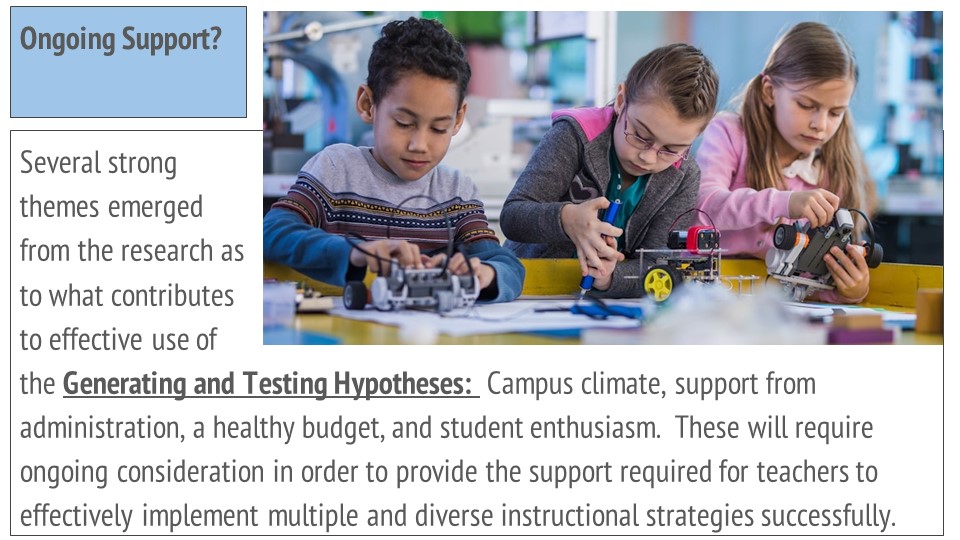
No instructional strategy works equally well in all situations.  As Marzano says, Instructional strategies are only tools.  Several themes emerged from the research as contributing factors to effective use of the GTH instructional strategy success. Campus climate, support from administration, a healthy budget, and student enthusiasm, were needed for successful implementation of strategies.  So, what is needed to sustain this and to really provide support for teachers who effectively use this strategy. We are lucky in that the district and community are partners in this endeavor with a local Foundation granting $10,000 for the Makerspace and PTO has allocated another $3,000 for Makerspace and Outdoor Classroom.  The implementation of instructional strategies could positively impact students, the school, and the community at large. 

  1. Avneet Hira A., Hynes M. (June 2018). People, Means, and Activities: A Conceptual Framework for Realizing the Educational Potential of Makerspaces Hindawi Education Research International Volume 2018, Article ID 6923617, 10 pages, Retrieved from Dean B. Ellis Library https://doi.org/10.1155/2018/6923617
  2. Bughin J.,  Hazan E., Lund S.  Dahlström P. ,  Wiesinger A, Subramaniam A. McKenzie,  (May 2018). Global Institute SKILL SHIFT AUTOMATION AND THE FUTURE OF THE WORKFORCE,  Retrieved from https://www.mckinsey.com/~/media/McKinsey/Featured%20Insights/Future%20of%20Organizations/Skill%20shift%20Automation%20and%20the%20future%20of%20the%20workforce/MGI-Skill-Shift-Automation-and-future-of-the-workforce-May-2018.ashx
  3. Erena A., Coskunb H. (December 2014). Students’ level of boredom, boredom coping strategies, epistemic curiosity, and graded performance.  The Journal of Educational Research, Volume 109, 2016 – Issue 6, Retrieved from Dean B. Ellis Library http://dx.doi.org/10.1080/00220671.2014.999364
  4. Google Education (May 2019) Emerging Trends in K-12 Education: Global Edition Retrieved from https://edu.google.com/latest-news/future-of-the-classroom/?modal_active=none
  5. Lawson A. (2003) The nature and development of hypothetico‐predictive argumentation with implications for science teaching, International Journal of Science Education, 25:11, 1387-1408
  6. Lee J. Kwon Y. (November 2010) Learning-Related Changes in Adolescents’ Neural Networks During Hypothesis-Generating and Hypothesis-Understanding Training Springer Science+Business Media B.V. 2010
  7. Levyhh, M. (November 2008). The Affective Establishment and Maintenance of Vygotsky’s Zone of Proxmial Development. Educational Theory, Vol. 58 Issue 1, p83-101. 19p. Retrieved from Dean B. Ellis Library http://eds.b.ebscohost.com.ezproxy.library.astate.edu/ehost/detail/detail?vid=3&sid=313a1a0a-c896-4064-a823-57b6c0e97e8c%40pdc-v-sessmgr03&bdata=JnNpdGU9ZWhvc3QtbGl2ZQ%3d%3d#AN=28794170&db=trh
  8. Marzano R., Gaddy B. Dean C. (2003). What Works In Classroom Instruction, Chapter 9 p. 111-120 Retrieved from http://www.peecworks.org/peec/peec_research/I01795EFA.3/Marzano%20What_Works.pdf
  9. Marzano, R., (2003) What works in Schools: Translating Research into Action, Alexandria, VA, Association for Supervision and Curriculum Development
  10. Maraono R. (September, 2009) Setting the Record STRAIGHT on “High-Yield” Strategies, Source: Phi Delta Kappan Retrieved from http://content.ebscohost.com/ContentServer.asp?T=P&P=AN&K=504319714&S=R&D=eue&EbscoContent=dGJyMNHr7ESeqK84yOvqOLCmr1Gep7ZSsau4TK%2BWxWXS&ContentCustomer=dGJyMPGut1Cwr7RRuePfgeyx44Dt6fIA
  11. Peppler K., Bender S., (November 2013).  Maker Movement Spreads Innovation One Project at a Time, retrieved from Retrieved https://journals.sagepub.com/doi/10.1177/003172171309500306
  12. Tan, M. (September 2018) When Makerspaces Meet School: Negotiating Tensions Between Instruction and Construction.  Journal of Science Education and Technology (2019) 28:75–89 Retrieved from Dean B. Ellis Library https://doi.org/10.1007/s10956-018-9749-x
  13. Tatter G. (April 2019) Teaching for Deeper Learning: How great teachers inspire class participation, student engagement, and learning Harvard Graduate School of Education Usable Knowledge Retrieved from https://www.gse.harvard.edu/news/uk/19/04/teaching-deeper-learning
  14. Stornaiuolo, A. & Nichols, T.P. (2018). Mobilizing Audiences in High School Makerspaces. Teachers College Record, 120(8),. Retrieved July 21, 2019 from https://www.learntechlib.org/p/189296/

Value Teacher’s time, improve job satisfaction

In a recent class project for an Education Specialist course, I conducted a small action research project to try to determine potential causes of teacher frustration.  We all know the facts.  Teachers have a reputation for being one of the most stressed and underpaid professionals and they are leaving the profession.  According to the U.S. Bureau of Labor Statistics (BLS), there were approximately 10.6 million educators working in public education in January 2020; today there are just 10.0 million, a net loss of around 600,000.  Teacher shortages are affecting schools across the country.

The area of focus for the action research was on Operations and Management.  Essentially, the ability of leadership to promote the current and future success and well-being of each student and adult by applying the knowledge, skills, and commitments necessary to improve management, communication, technology, school-level governance, and operation systems.

I assessed the amount of time teachers spend on non-value added tasks (tasks or requests that do not add to the mission or operation of the school, influence the learning environment or improve the processes or procedures of the classroom or building operation.   In comparison to value added tasks (tasks is that inform teaching practices, create positive learning experiences, advocate for the teaching profession, etc.)  

I asked a group of high school teachers to document anytime they spent time on a non –value added tasks.  In a small, short investigation, I discovered that teachers could spend up to 10% of their day on non-value added tasks.  Tasks like entering grades. Not grading, which is used as a variable to assess student progress, I mean the actual manual setting up of an assignment in a gradebook across multiple class periods and multiple buildings.  The gradebook and attendance tool is a converted database tool that hosts important student data so required to use, but a cumbersome tool that can take several minutes to load and update.  Audio visual issues with hardware and software that do not work properly, or the processes and technology required to set up testing,  student parking issues, burdensome tools and processes that get in the way of relationship building amongst teachers and students. 

Teacher Contracted time in Hours per day 7.75
Teacher Contracted time in Minutes per day465.00
If Time spent on Non Value Added Tasks – 3% per teacher (lost time in minutes/day)13.95
Lost Labor in Minutes (all staff)4,883
Lost Labor in Hours (all staff)81.38
If Time spent on Non Value Added Tasks – 10% per teacher (lost time in minutes/day)46.50
Lost Labor in Minutes (all staff)16,275
Lost Labor in Hours (all staff)271.25

The impact to both labor costs and morale and culture is significant.  A teacher can lose from 14 minutes – 48 minutes per day to non-value added tasks.  At one high school with a staff of 350 and a student population of approximately 3,000, teachers spend between 3%-10% of time on non-value added tasks that represents 81 – 271 labor hours lost each day for the school.   For teachers, being asked to continue these non- value added processes without an acknowledgement or justification, there is certainly an impact to culture/morale and overall job satisfaction. 

Effective educational leadership is complex, but an awareness of what is happing at all levels of the building and the willingness to address problems and implement solutions with team input can be an effective, leadership practice that may not be as time consuming as we think, especially if we consider the impact of losing labor hours to non-value added tasks.

Black History Month

Since this year’s theme for Black History month is “The Black Family” I wanted to share a story of personal significance. A story to remember the family leaders that faced challenges and carved paths that set the foundation for generations to come. 

My uncle, Lemuel Collins, integrated Subiaco Academy in Arkansas in the fall of 1957.  He was one of two black students to enter Subiaco Academy that fall.  If the year 1957 rings a bell, that is because that same month, just 108 miles to the east, nine Black students enrolled in Little Rock Central High School, but were prevented from entering the school by Arkansas Governor, Orval Faubus. 

Three years earlier in 1954, the Supreme Court had ruled that segregation in public schools was unconstitutional, but while the Arkansas Governor was arguing that “a suitable educational system cannot be maintained on an integrated basis”, the Roman Catholic Diocese of Little Rock were discussing the immorality of segregation.  Many assumed private schools would stay segregated but, Abbot Paul Nahlen directed that Subiaco Academy would be open to all men regardless of race. Lemuel courageously and boldly entered an all-white school in the Fall of 1957 when the national conversation on desegregating schools was at a critical and frightening boiling point.

My son asked me if there were armed guards there to protect Lemuel, wondering if the scene at Subiaco Academy was similar to the pictures of integration that he has seen of the Little Rock Nine or Ruby Bridges.  The answer was no.  I can only imagine, but knowing my uncle, it was just a bold and confident 16-year-old ready for a new challenge and educators with exceptional ethics and a strong moral conviction ready to receive him.   

A common thread that runs through those that we celebrate during Black History month is that they do not crumble under pressure.  I use this story as motivation for myself to reflect on what is in my sphere of influence.  What areas may not be central to the operation of the classroom, but critical to maximizing the human potential of everyone in the classroom.  There is no doubt that progress in equality has been made, but as we begin 2021 against the backdrop of serious evaluations of social and economic systems, there is still much work to do. 

References:

Rev. Albert L. Fletcher, Bishop of Little Rock, “An Elementary Catechism on the Morality of Segregation and Racial Discrimination,” American Catholic History Classroom, accessed February 8, 2021, https://cuomeka.wrlc.org/items/show/911.

Kodell J., Winter 2021, The Abby Message – “The Passing of a Subiaco Trailblazer” Retrieved from electronic message B. Milum

The Power of the Streak

In May 2019, I read a Runner’s World article that issued a challenge to its readers to start a running streak from Memorial Day to Independence Day.  At the time, my seven-year-old son and I were training for a two-mile glow run that was to take place on May 31st, so I did not want alter our twice-a-week training program and overload him with extra miles.  Memorial Day passed, and later that week, we went on and enjoyed our two-miler together in the late hours of May 31st.

On June 1st, I could not help but think of that Runner’s World challenge of starting a running streak of running at least one mile a day.  My son completed his run and was done with running for a while, so I was free to run on my own.  I went out in the neighborhood to run a mile and extended my streak to two days.  “The streak of 2019” was born.

Rewinding a bit, I would say my fondness of running started around January 2003.  I ran a little off and on prior to that, but I had recently started a position where I prepared sales tax returns in Excel spreadsheets.  I liked the idea of using Excel to track my runs, so I have documented every mile I have run since then.  Incentivized by the tracking, I have run at least one mile per calendar month for the past 17 years (and counting).

Keeping track of various stats, I knew I had a 10-day running streak back in 2008, so I figured 2019 was a good time to break it.   Over the past several years, I have been training regularly for half marathons.  At the height of my training, a typical week is 3 miles on Tuesday, 3 to 5 miles on Wednesday, and a long run of 6 to 12 miles on Saturday.  I like to get plenty of rest a couple days before and after the long runs, so I am accustomed to taking several days off during the week and therefore not getting any kind of streak going.

But half marathons are usually in the spring and fall, and there is little motivation to run long runs in the summer because of the heat.  For me, a one-miler is manageable regardless of temperature.  I would eventually break my 10-day streak and extend it to 25 days the morning my family left on a four-day vacation.  I did not want to make the streak the focus of our trip and had already accomplished what I wanted, so I was happy to end the 2019 streak.

Fast forwarding to 2020, I completed my 31st overall half marathon in April with the last two being virtual due to COVID-19.  Now that my half marathon season was over and we were in the early stages of a global pandemic, I did not feel very motivated to run.  Then I thought back to my streak of 2019.  May had been one of my worst running months, and I had never run every single day of a month before.  So I decided it was a good time to try “a mile a day in May.”  I was working from home because of the pandemic, so it would be convenient to knock out the run early before work, during work between meetings, or after work if necessary.  I notified my wife of my intentions, and she suggested that our son join me on the runs.  My son agreed to try it, so I created and printed a 10-day running challenge sheet for him.  The May 1st run was a bit rough since he had not run in about a year, but he powered through and we finished in just over 12 minutes.

The next day we ran about a minute faster than the day before, and then stayed the night away from home.  On the morning of the 3rd, my son had some discomfort from the previous day’s run because he did not have appropriate running gear, so he did not want to run.  I decided to go on my own to extend my streak.  My goal for him initially was to run just 10 days in May, so we had plenty of days left for him to do that.  But when we got home that evening, he wanted to run, so I ran again with him, and we extended his streak to three days.  I was a proud father that he took the initiative to keep going.

Because I am having to work more due to the additional Zoom meetings brought on by COVID-19, the daily run and cool down walk were a great way to spend time with my son.  To incentivize him to keep going, we sweetened the pot by giving him prizes for certain milestones such as books from his favorite series or coupons for extra screen time or desserts.  Knowing he would get a prize for his 10 miles in May, he requested running a second mile on May 9th, and my wife was at the finish line to present him with his certificate.

Instead of stopping there, he kept going with me.  He ran a bit more so that he could get 13.1 miles for a half marathon, 16.2 miles for a ‘”double down” (5K + half marathon), and 26.2 miles for a full marathon.    There were a few times where he and I were separated, but we both ran independently to extend our streaks.  We would both achieve my initial goal of running every day in May, breaking my streak from 2019.  And we kept going, running every day in June and July as well. 

The one-mile run had become part of our daily routine, almost as natural as brushing our teeth.  The streak also improved our speed and endurance.  One of our runs was 8:58 which was a vast improvement over the 12:06 mile on Day 1 in May. 

Streaks have power.  The longer ours became, the bigger the incentive it was to keep going.  In these summer months being stuck at home in a pandemic, a simple 10-minute stroll outside with my son each day was a positive experience for both of us.  Sometimes we would drive to a different place just to mix things up with a new route.  On August 8th, we ran for the 100th straight day, and we made it a big occasion.  We got a cookie cake, another certificate with coupons, and a few other gifts.  And because of the milestone, we ran in the rain because we were both eager to knock it out.  That’s what was great about the streak.  We ran even when it was not the most convenient.

My son decided he did not want to run on August 9th.  He was proud of his 100 straight days, and his mother and I were proud of him.  I am glad he found a good stopping point.  Sometimes it can be difficult to end a streak.  I decided to keep going by on my own and am now at 115 days and counting.  I even started a streak within a streak, running at least two miles a day (10 days and counting).  I have no intention for my streak to get too out of hand though.  I read about a man who ran at least a 5K (3.1 miles) every day for 1,000 consecutive days despite injuries, illnesses, bad weather, and vacations.  Such a commitment is impressive, but some negative side effects can be possible if a streak is too extreme. 

Although my son has not run since the 100th day, he has gone on several long walks with me, my wife, and my mother-in-law.  He was proud to tell me of times when he ran faster than some of his friends who were riding their bikes.  I can tell the streak has helped his confidence and has improved his endurance, even when he is not running.  But my son is not quite done running just yet.  He and I signed up for a virtual 5K in September.

Streaks can be helpful in other areas of life.  May was my weakest running month, but “the streak of 2020” gave me my first ever month where I ran every single day.  There can be limitless other kinds of streaks.  For our health, we can add an exercise goal like this ‘mile a day’ streak or add nutrition streaks.  For example, if you feel you are not eating enough vegetables, you can start a vegetable streak.  It may take a few days to get into a routine, but once you get going, you might eventually be substituting fries for a salad at dinner to keep your streak going.  Good streaks can be used to replace bad streaks.  Think of a recovering alcoholic who is trying to stay sober.  They are given coins to commemorate sobriety milestones which also serve as a reminder to keep their streak going.  The streak itself is powerful, but extra incentives and support also help.

In education, students can start a reading streak, like reading 15 or 30 minutes a day.  I remember the ‘Book-It’ program as a kid, and when I read enough books, I was so excited to get a Pizza Hut personal pan pizza for my efforts.  Tracking all the books I read and receiving an incentive kept me going.  As a byproduct, I read more than I normally would have and moved up to be with the advanced readers the following year.  If you know a student who is weak in math, you can help by starting a streak of completing extra math problems such as running through a stack of flash cards.  After a set number of days in a row of committed effort, you can all go out for ice cream.  While enjoying the treat, your child may not realize it, but their math skills will likely have improved compared to what they were before the streak began.  And who knows, they make be asking you for more math problems!

So if you, your child, or your student has an area of interest or a weak spot, I recommend you consider the benefits that a streak can bring.  Make the streak visible on a calendar or checklist so the progress can be seen.  If you are supporting someone, provide encouragement and some incentives along the way.  And once the streak is part of your routine, enjoy the rewards!

GroupMaker – Building Classroom Culture and Professional Skills through ensuring group variety

A key staple of my classroom is utilizing the profession-based learning.  This PBL model helps me to build a classroom culture where the expectations are high and a collaborative attitude prevails.  Similar to problem-based learning, project-based learning, and place-based learning, students work in small groups, on authentic problems. These projects give students a chance to learn and apply content and also develop their soft skills.  The projects are authentic, often provided by the community, multi-week endeavors, and collaborative in that students are contributing individual strengths and skills to a shared piece of work in partnership with their peers, teachers, and mentors from the community.

I am clear with students that one of the goals of the projects, in addition to learning content, is developing skills like communication, leadership, critical thinking, and teamwork skills.  Skills they can take into their internships the following semester and to their post-secondary ventures.  As students work together, I want them to consider questions like,

  • Am I an effective team member and/or leader?
  • How well do I read people or the situation?
  • Does my leadership style bring out the best in my teammates?

In order to answer these questions, students need practice.

Profession-based projects are a great way to develop essential skills

In facilitating these types of projects, the problem I found in trying to help students develop their collaboration and communication skills was taking time to put students in groups, but also taking into account who has worked together on previous projects.  After the first couple of projects I would wonder, “has every student had a chance to work with everyone else?” I could not keep track. 

Random name generators were helpful on the first project, but I wanted to make sure subsequent projects offered a different grouping than the first project.  Random name generators could not facilitate this and I found it too time consuming to keep up with who had worked with whom.

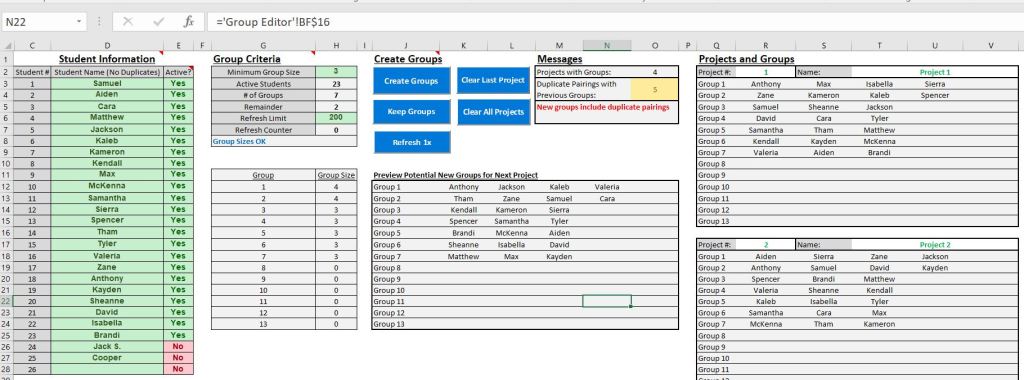
“GroupMaker” is a tool built in Microsoft Excel to assign student groups for projects, but takes into account who has worked with whom previously so that nearly all students have a completely different group to work with each project.

A teacher would key in their roster and the ideal group size.  Then press “Create Groups’

This gives the teachers a preview for the student grouping.  If it is acceptable the teacher selects “Keep Groups.” This puts the student grouping into “Project #1.”

Then for Project #2, the teacher again selects “Create Groups.”  This creates another student grouping that is different than Project #1. 

The more projects a teacher creates groups for, the harder it is to create student grouping where students have not worked together, but with 22 students and groups of 3 students, I can get through 4 projects with different groups. 

This gives students the chance to meet and work with as many different students in the class as possible over the course of the projects we do each semester.  There are several benefits to grouping students this way, but the biggest benefit is that each project gives students the opportunity to learn from the previous group dynamics and improve going into the next project.  By the end of the fourth project, students are more confident about the strengths they bring to the group and they have experienced a variety of situations that allowed them to improve their leadership and communication skills.

Small group work in classrooms is challenging.  Preparing students for internships and other post-secondary work is challenging.  Taking into account curriculum standards, projects, individual students, essential skills development, content, community partners, all provide variables to consider, but students who do small group work generally learn more of the material and retain their knowledge longer than students who don’t.  In the workplace today, the skill of collaboration is imperative and making sure students have this skill set will help them be more productive and competitive.  The GroupMaker was useful for me and if you create groups for long-term projects this might be helpful to you as well. 

GroupMaker is available for download on

https://www.teacherspayteachers.com/Product/GroupMaker-5802251

A GroupMaker instructional video is available on YouTube here

Racial Stress in Schools: Curriculum Literature Review

In reviewing the article “Choosing to see the racial stress that afflicts our Black Students”,  the key point is that given the mental consequences of discrimination and racism experienced by the vast majority of Black children while in our schools, our education institutions must play a leading role in alleviating racial stress. Some educators believe that it is noble to avoid looking directly at race.  However, evidence indicates that when we choose not to talk to our students explicitly about race and racism, it can be detrimental to the educational experience of black youth.  The article goes on to suggest ways educators and school systems can go about this. 

First, schools should take a more active approach to helping black youth address racial stressors by providing a curriculum that encourages discussions about race and racism.  Second, education systems need to increase teacher training to foster competent classroom practices. Third, educators need to build stronger relationships with black parents and community members. A new concept for black youth in particular, is the negative physical, psychological, physiological and academic effects of racism include being hyper-vigilant about potential acts of racism.  I have observed hyper-vigilance in K-12 education systems, however I did not equate this to symptom of racial trauma.  A student navigating an educational system that is potential causing psychological problems due to race can include diminished self-esteem and decreased school engagement. 

While I strongly agree with the premise of the article and the suggestions provided, I would highlight a potential misunderstanding that can occur if educators adopt the suggestions from the article at surface level.  The article suggests taking an active approach by adopting a curriculum that encourages discussions about race and racism.  Based on personal experience, I have seen severe missteps by educators in the high school setting, particularly in Social Studies and English courses, when it comes to improving the diversity and inclusion in their curriculum.  Simply adding diverse authors or using resources that address racism can negatively impact the black students in the class if they are expected to add the “black perspective” or define for the class what is and is not racism.  This actually adds to the racial stressors of students particularly in schools that are predominately white.

This is a challenging task, but with the partnership of curriculum experts and diversity and inclusion experts the design of curriculum coupled with excellent teacher practices could positively impact students.

References

Anderson, R. E., Saleem, F. T., & Huguley, J. P. (2019). Choosing to see the racial stress that afflicts our Black students. Phi Delta Kappan, 101(3), 20–25.

The teacher as a maker of the curriculum and the importance of a joy for learning

The Bentonville school district has experienced recent success in implementing new curriculum, instructional strategies and utilizing new instructional coaches in math and literacy. Teachers in the district have exemplified excellent instruction that has resulted in strong test performance and when compared with other districts in the state, Bentonville ranked first in 29 out of 32 Subject/Grade Level Combinations for the 2018-2019 school year on ACT Aspire Testing (D. Jones, Superintendent Bentonville Schools, email communication, July 17, 2019). Strong performance on tests are certainly one measure of instructional skills in the classroom and knowledge in making curriculum, but there is a missing element critical for continued success for teachers and students. Effective teachers create a joy of learning in the classroom and if this can be replicated in classrooms across the district, we can make student learning more successful and long term.

A case study analysis (Stronge, Ward, Grant 2011) identified variables that are practices of effective teachers. The analysis indicates that teacher effectiveness requires mastery of classroom management, encouragement of responsibility, classroom organization and positive relationships. The most significant variable in illustrating the difference in effective and ineffective teachers can be summed into a theme of joyful learning. Effective teachers strive to create a joyful classroom that is engaging and promotes and supports intellectual curiosity.
Creating a joyful classroom requires purposeful strategies in these three areas which manifest as the personal qualities of vulnerability, cooperation and ownership.


Strategy 1 – Share Vulnerability
Modeling vulnerability is about sending a really clear signal in the classroom that indicates that it is OK to make mistakes, to trust each other and get to work. A teacher showing vulnerability allows the students build responsibility over their own their learning experience. Joy in learning requires some ownership on the part of the learner and sharing vulnerability helps to build a culture that encourages responsibility.

Strategy 2 – Build Cooperation
The core of effective teacher and student relationships is a healthy balance between dominance and cooperation (Marzano 2003). Effective teachers utilize cooperative actions to build positive relationships like allowing students to set some of their own learning goals, have input regarding rules and procedures in the classroom. Cooperation in the classroom builds a joyful learning environment where the teacher is able to utilize helpful skills to meet the needs of students in the classroom.

Strategy 3 – Create ownership (Classroom management and organization)
The analysis found that teachers who were more effective, in terms of student achievement, were more organized, used routines and procedures with greater efficiency, and held higher expectations of their students’ behavior (Darling-Hammond 2003, p.348). As part of a joyful classroom, effective teachers create a culture in which both the teacher and the students are responsible for maintaining the classroom. Additionally, because the procedures are in place and the students are excited to learn and this lends itself to the teacher being able to utilize more instructional strategies and differentiation in the curriculum.

Conclusion
With six to ten years of teaching experience, Teachers appear to decline in cooperative behavior, a change that negatively affects student attitudes. (Marzano 2003). Therefore years of experience are not a prerequisite to effectiveness. If all teachers in the school are not only building curriculum that results in great test scores, but builds a joy for learning, the school can have tremendous impact on student achievement, student success and student joy. Considering the high turnover of teachers in schools, it is in everyone’s interest to help teachers and students find joy in their work.

References:

  • Coyle, Daniel (2018) The Culture Code: The Secrets of Highly Successful Groups, Random House New York.
  • Darling-Hammond, L. (2003). Keeping Good Teachers: Why It Matters, What Leaders Can Do. Educational Leadership, 60(8), 6-12
  • Marzano, R., (2003) What works in Schools: Translating Research into Action, Alexandria, VA, Association for Supervision and Curriculum Development
  • Stronge J., Ward T. & Grant L. (2011). What Makes Good Teachers Good. Journal of Teacher Education, 62(4), 339-355.

The nature of elementary curriculum structures

Schools across the nation constantly evolve to meet the needs of a more demanding and ever changing workforce.  The curriculum adopted by elementary schools within the Bentonville School district have the best intentions, but may not achieve the desired outcome with the current content based curriculum.  The intended curriculum aspires to prepare our students to be not just competitive, but successful in the variety of ways they will eventually serve their communities, but a critical factor of adding in societal-centered is needed in the curriculum to increase its effectiveness.

Current Curriculum

The current curriculum for elementary which is defined for Bentonville School District as K-4, focuses on grade-specific concepts and skills in four content areas: English Language Arts, Mathematics, Science and Social Studies. (Bentonville 2018) The grade-level standards articulate clear goals for students and parents and they are aligned to Common Core State Standards and Arkansas Curriculum Frameworks.  This has served the district well as state measures of academic progress place Bentonville as a top district for the state of Arkansas.  9th grade literacy scores at Bentonville Schools confirm that 64.07% of students are ready or exceeding in literacy skills, while the average score for the state of Arkansas is 44.06%.

Addition of Society Factor in Curriculum

While the clarity of focus is appreciated by the community and easily measured, based on my experience over the last 2 years in placing 40 high school students in high quality, career-focused internships, the standard content based curriculum, leaves students unable to weave the content together and bridge the isolated content together in order to problem solve, think critically, and make decisions.  This is critical for our students as the World Economic Forum reports that “by 2030 there will be huge demand for higher cognitive skills such as creativity, critical thinking and decision making.” (Jezard 2018).  In context to content based curriculum, “The placement of basic concepts and procedures has been perhaps too narrow.” (Klien 1986). 

In the research provided in the article, Alternative Curriculum Designs by Frances Klien, multiple research teams have separately identified the concept of a societal-centered curriculum that focuses not only on content, but developing curriculum which connects the content areas and also connects students to their communities and society. “Problems and dilemmas of society are what ought to be studied by students.” (Klien 1986).  As noted in the article, Tyler’s syllabus, Basic Principles of Curriculum and Instruction identified society as a critical component of curriculum development. Klien goes on to share that “most curriculum scholars have long advocated the use of both subject-centered and societal-centered.  A third research summary in the Kline article by Eisner and Vallance suggested that curriculum look to society as a basis for the substance of curriculum (Klien 2018).  In the view of these curriculum experts and my experience with high school students there is another level of curriculum development that is required to make curriculum effective for students.  The content knowledge is absolutely essential, but often elementary students view math content as an isolated part of their day and reading as a skill only used during literacy lessons. 

Conclusion

Ultimately, schools are correct to focus on content based curriculum, but content only curriculum is not preparing students for the cross-curricular, cross-functional learning needed to be competitive and successful.  The missing piece is students’ being able to weave the curriculum across all content in order to solve problems, look at issues with a critical lens and make decisions while weighing the potential outcomes and consequences. These skills are developed from a foundational knowledge of the content, but students also need to apply it in the context our society and how the workforce expects students to be able to utilize their knowledge and skills.  Content based curriculum is easy to track and measure, but it limits the ability of the school and the educators from meeting the needs of the students and our community. 

References:

  1. Bentonville Schools Elementary School Student Handbook (July 2018), Bentonville Schools, Retrieved from https://ar02203372.schoolwires.net/site/handlers/filedownload.ashx?moduleinstanceid=32522&dataid=31538&FileName=Elementary%20Schools%20Handbook%202018-2019%20-%20FINAL.pdf
  • Klein, M.F. (Winter 1986) “Alternative Curriculum Conceptions and Designs,” Theory into Practice: 21. pp. 31-35
  • Marzano, Robert J., (2003) What works in Schools: Translating Research into Action, Alexandria, VA, Association for Supervision and Curriculum Development
  • Morrow, Jennifer. (June 2019) “Awareness Training Module 1 of 18 Rise Arkansas the Science of Reading Bentonville Schools.” PowerPoint presentation. Bentonville High School. Bentonville, Arkansas. 3 June 2019. Keynote address.
  • Munson Lynne (March 2011) “What Students Really Need to Learn”, Educational Leadership, Vol. 68, Issue 6 pp. 10-14 Alexandria, VA, Association for Supervision and Curriculum Development